This post may contain affiliate links. As an Amazon Associate I earn from qualifying purchases, at no extra cost to you.
Introduction
The ease of a recumbent bike's comfortable seat frequently poses a major issue: is this low-impact exercise that is low impact really efficient, and if so, what muscles do I actually work?
Recumbent bikes offer an intense, low-impact cycling workout that is primarily focused on toning and strengthening the main muscle groups in the lower body such as the quadriceps, glutes, and hamstrings.
This complete guide offers an in-depth, muscle-by-muscle analysis of the recumbent bike exercise and explains how the unique cycling position impacts muscle engagement. It also offers strategies to maximize every turn to build strength and endurance.
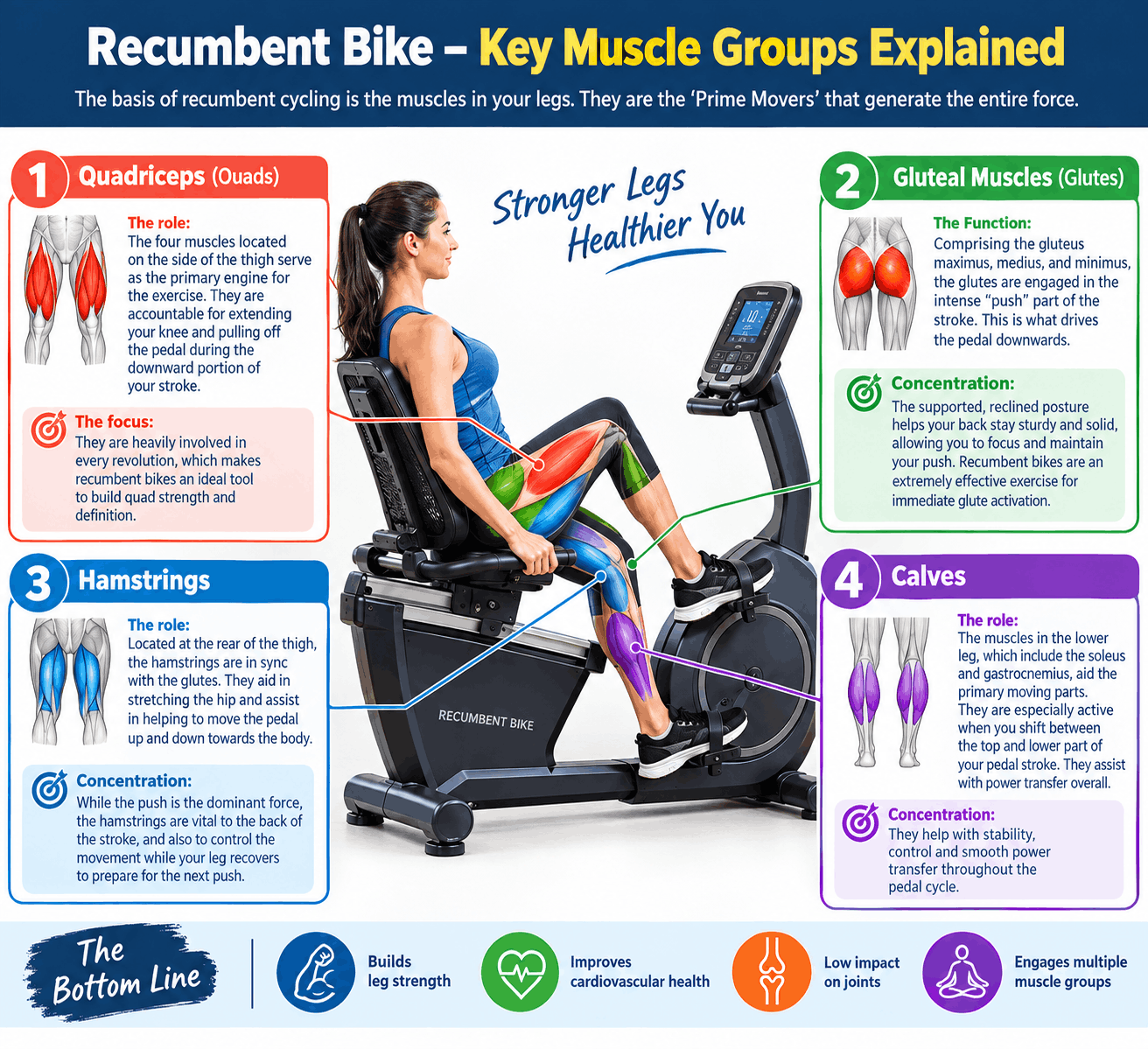
Recumbent Bike – Key Muscle Groups Explained
The basis of recumbent cycling is the muscles in your legs. They are the 'Prime Movers' that generate the entire force.
1. Quadriceps (Quads)The role: The four muscles located on the side of the thigh serve as the primary engine for the exercise. They are accountable for extending your knee and pulling off the pedal during the downward portion of your stroke.
The focus: They are heavily involved in every revolution, which makes recumbent bikes an ideal tool to build quad strength and definition.
2. Gluteal Muscles (Glutes)The Function: Comprising the gluteus maximus, medius, and minimus, the glutes are engaged in the intense "push" part of the stroke. This is what drives the pedal downwards.
Concentration: The supported, reclined posture helps your back stay sturdy and solid, allowing you to focus and maintain your push. Recumbent bikes are an extremely effective exercise for immediate glute activation.
3. Hamstrings: The role: Located at the rear of the thigh, the hamstrings are in sync with the glutes. They aid in stretching the hip and assist in helping to move the pedal up and down towards the body.
Concentration: While the push is the dominant force, the hamstrings are vital to the back of the stroke, and also to control the movement while your leg recovers to prepare for the next push.
4. CalvesThe role: The muscles in the lower leg, which include the soleus and gastrocnemius, aid the primary moving parts. They are especially active when you shift between the top and lower part of your pedal stroke. They assist with power transfer overall.
Secondary and Stabilising Muscles/What Muscles do Recumbent Bikes Work
1. Abdominals (Core)The Function: While far less active than when riding an upright bicycle (where they keep their balance), the abdominals, as well as lower back muscles, continue to act as stabilizers.
Insight: They help maintain an upright posture and a stabilized pelvis, particularly when you are able to increase your resistance and put in more effort.
2. Tibialis Anterior: The Function: This often-overlooked muscle is located on the lower leg's front, specifically your shin. It lifts your foot and plays a role during the recovery phase of the pedal stroke.
Insight: Its engagement demonstrates the depth of knowledge and expertise that recumbent bikes affect every part of the lower leg and not just the major muscles.
Recumbent Bikes Comparison
How Muscles Work Through the Pedal Cycle/What Muscles do Recumbent Bikes Work
Conclusion/What Muscles do Recumbent Bikes Work
The recumbent bicycle is more than just a relaxing alternative; it's an effective tool for performing low-impact exercises. With its sturdy, well-supported platform, it effectively targets and strengthens the hamstrings and glutes as well as the quadriceps and calves with every turn.
If you know the muscles you're focused on, you can modify your training sessions--increase resistance and speed to effectively achieve your fitness goals. Prepare to pedal and work towards healthier legs with our collection of recumbent bikes at