
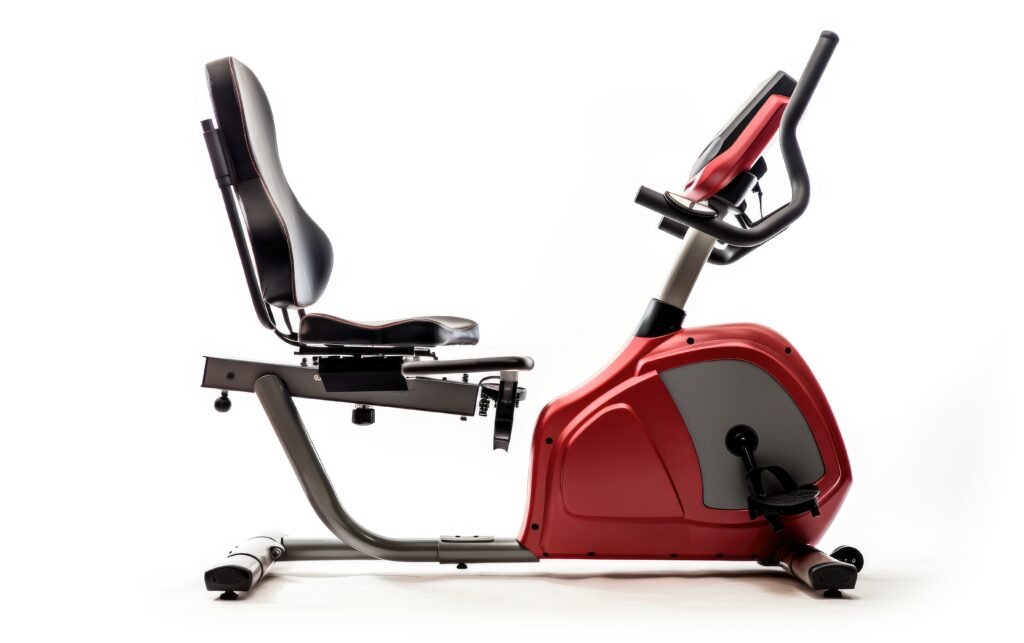
what muscles does the recumbent bike work

What Muscles Does the Recumbent Bike Work?

This post may contain affiliate links. As an Amazon Associate I earn from qualifying purchases, at no extra cost to you.

Introduction

What Muscles Does the Recumbent Bike Work? The quadriceps, hamstrings, and glutes are the main lower-body muscle groups that may be strengthened and toned with a vigorous, low-impact seated cycling workout on a recumbent bike.
This thorough book breaks down the recumbent bike workout muscle by muscle, examines how the particular riding position influences muscle engagement, and includes advice on how to maximise each revolution for strength and endurance.

What Is a Recumbent Bike?

Because your body orientation on a recumbent bike differs greatly from that of a standard indoor bike, they are a special kind of exercise bike.

A recumbent bike places you in a flat plane with your pedals out in front of your centre of gravity, as opposed to sitting over the pedals and drivetrain. The seat itself is different from a standard bike saddle in that it has a strong backrest for better ergonomics and comfort.

Recumbent Bike Comparison

Brand

Bike Weight

Material

Maximum Weight

YOSUDA

58.3 pounds

Alloy Steel

350 pounds

XVGVSV

66 pounds

Metal

400 pounds

XVGVSV

66 pounds

Metal

400 pounds

XVGVSV

66 pounds

Metal

400 pounds

Niceday

84 pounds

Alloy Steel

400 pounds

MERACH

57.3 pounds

Metal

300 pounds

MERACH

57 pounds

Metal

300 pounds

Recumbent Bike  – Key Muscle Groups Explained/What Muscles Does the Recumbent Bike Work
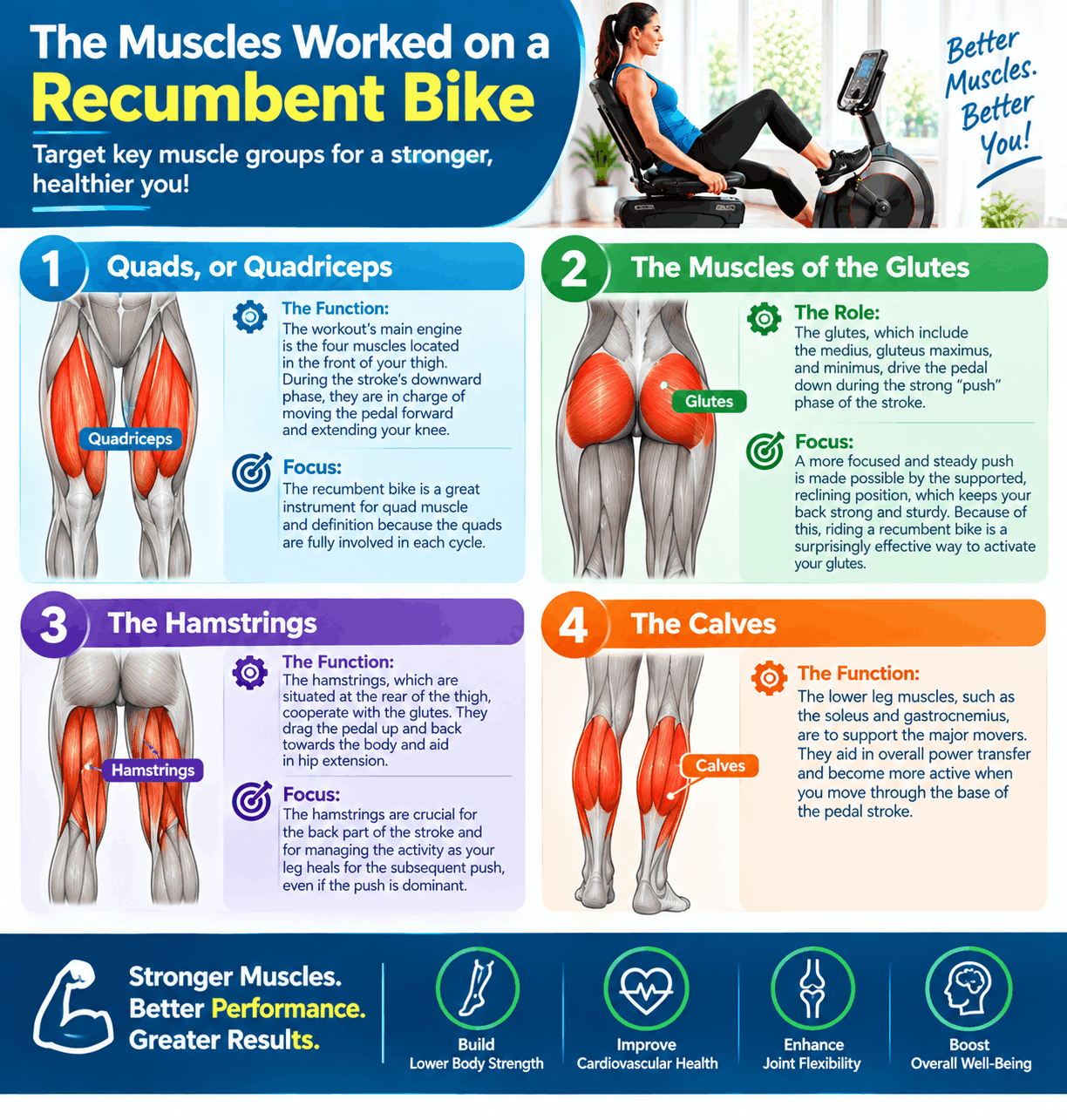
1. Quads, or quadriceps

The Function: The workout’s main engine is the four muscles located in the front of your thigh. During the stroke’s downward phase, they are in charge of moving the pedal forward and extending your knee.

Focus: The recumbent bike is a great instrument for quad muscle and definition because the quads are fully involved in each cycle.

2. The muscles of the glutes

The role of the glutes, which include the medius, gluteus maximus, and minimus, is to drive the pedal down during the strong “push” phase of the stroke.

Focus: A more focused and steady push is made possible by the supported, reclining position, which keeps your back strong and sturdy. Because of this, riding a recumbent bike is a surprisingly effective way to activate your glutes.

3. The hamstrings

The Function: The hamstrings, which are situated at the rear of the thigh, cooperate with the glutes. They drag the pedal up and back towards the body and aid in hip extension.

Focus: The hamstrings are crucial for the back part of the stroke and for managing the activity as your leg heals for the subsequent push, even if the push is dominant.

4. The calves

The function of the lower leg muscles, such as the soleus and gastrocnemius, is to support the major movers. They aid in overall power transfer and become more active when you move through the base of the pedal stroke.

What Muscles Does the Recumbent Bike Work

Recumbent Bike vs Upright Bike/What Muscles Does the Recumbent Bike Work
Feature

Recumbent Bike

Upright Bike

Design

Reclined place with back support

Traditional tackle with no backrest

Comfort

More relaxed; reduces stress

Less satisfied; may cause stress points

Joint Impact

Low-impact; soft on knees/hips

Higher result; may emphasize joints

Muscle Engagement

Concentrates on the lower body

Immerses both the upper and lower body

Calorie Burn

Comparable when power matches

Comparable when power matches

Accessibility

Easier to mount; appropriate for injuries

Requires more balance; more difficult to mount

Space Requirements

Larger footprint

Smaller footprint

Cost

Generally more expensive

Typically more inexpensive

Does a recumbent bike work your glutes?

Indeed. During the power phase, the gluteus maximus aids in hip extension. Cycling is not a direct replacement for progressive workouts like bridges, squats, or hip thrusts, but it can enhance glute demand with medium-to-high resistance and proper seat positioning.

Can a recumbent bike build muscle?

Although it can help novices gain some muscle and lower-body strength, its primary muscular benefit is endurance. A stronger muscle-building motivation is provided by increasing overload, moderate-to-high resistance, sufficient protein, and independent strength training.

Does a recumbent bike strengthen your legs?

It can increase lower-body muscular steadiness and help with strength gains, especially for new or returning exercisers. Make use of steady resistance and slow progression. For sustained improvements, experienced trainees typically require more strength training.

What are the disadvantages of a recumbent bike?

Compared to your standard exercise bike, recumbent bikes are usually longer, which might be problematic for people who work out in cramped areas.

Additionally, the mild resistance levels frequently found on these machines may disappoint people who are interested in high-intensity cycling. We would recommend considering a spin or studio-style training bike for HIIT cycling circuits.

Conclusion: What Muscles Does the Recumbent Bike Work
What Muscles Does the Recumbent Bike Work? Recumbent bikes are a safe and adaptable way to test both novice and expert exercisers. They offer an efficient cardiovascular and lower-body resistance workout.
Your training is only as useful as the effort you put into it, regardless of the cardio equipment you use. To maximise the mental, emotional, and physical benefits of physical activity, give every session your all.

James Content and Seo Writer
0 0 votes
Article Rating
Subscribe
Notify of
guest
0 Comments
Oldest
Newest Most Voted
Scroll to Top
0
Would love your thoughts, please comment.x
()
x